It won’t have escaped your attention that artificial intelligence (AI) has gone stratospheric in 2023. Wherever you look, a dazzling array of AI solutions, apps and tools are appearing across numerous industries and professions. In itself, this isn’t a bad thing. Using the power of AI to automate dull and tedious processes is a positive move. And making the most of the immense brainpower of AI to analyse, review and sort complex data has the potential to deliver huge benefits for humankind.
But why are we using AI to replace that most human of skills: creativity?
Evolving the 20th century view of man vs machine
If we look back at the science fiction of the 19th and 20th centuries, the future was generally envisioned as one where machines were the benign assistants to humanity. Humans were seen as the intelligent beings, while robots were subservient tools, designed to make our lives easier.
This was a world where robots scurried around picking up our children’s mess, slaved away in factories bending our girders or acted as automated drivers for our hi-tech flying cars. And, to be fair, we do have ‘smart robots’ that vacuum our houses, cut our grass and deliver our parcels. But do the AI software tools we’ve developed in recent times fit into the same bracket as a robot vacuum cleaner? Or are they an altogether more sophisticated innovation?
The rise of ChatGPT and AI-created content
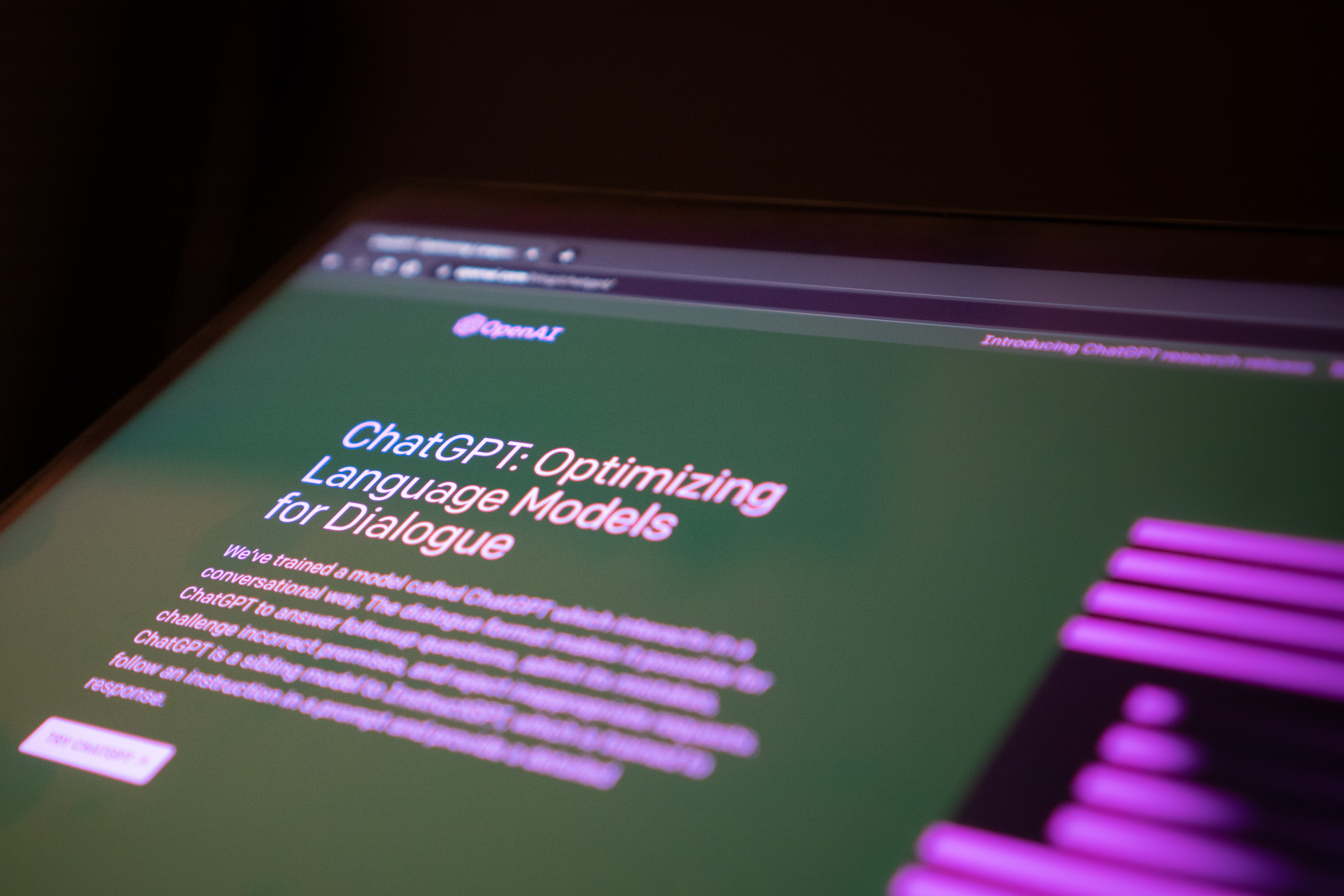
The big hit in the world of AI has been Open AI’s ChatGPT, a large language model (LLM) chatbot that’s revolutionised our perception of artificial intelligence.
ChatGPT is an LLM that has access to everything (yes, that’s *everything*) that was stored on the internet in 2021. So, if you ask ChatGPT to ‘tell me everything you know about making great coffee’, it will immediately give five excellent tips on becoming a better home barista. But, unlike Google’s search engine, ChatGPT doesn’t just answer your questions. It’s also a creator of content – and this is where things get a bit concerning…
I’ve been a writer most of my life, and a professional content writer for around 15 years. I take writing seriously and have spent a long time honing my craft, learning the tricks of the trade and making the content as unique and engaging as possible.
But if you sit down in front of ChatGPT and give it a written prompt that says ‘Write me a 1,000 word article about what it’s like becoming a new parent’, it will do just that – in a matter of seconds. The distant server will chug away for a few milliseconds, the algorithm will consult every reference and data source it has relating to babies and being a good new parent, and the software will dash off a thousand words, all grammatically correct and spell-checked (well, spell-checked if you want American English anyway).
And there you have it. A reasonably OK article about being a parent for the first time. It’s not great, but it’s also not terrible either. As I said in another recent blog post, what you get is the two-minute noodles of written content. Yes, it fulfills the hunger for more words on a given topic, but it’s definitely not an article that’s been cooked up by the unique mind of a human.
It’s acceptable, but it’s vanilla. And, increasingly, humanity doesn’t seem to mind this. But should we really be using AI to communicate such a human experience?
The void of human experience in AI content
ChatGPT is an amazing tool – there’s no denying that. I have used it myself to come up with rough outlines for blogs, or to write topic-specific bullet points around a given theme. And, if we’re honest, there’s not much this LLM can’t write.
Ask ChatGPT to write you a Shakespearian sonnet about unrequited love, and it will write one. Tell it to write a short childrens’ story about a bunny called Binky, and it will scribble that story out for you. Instruct it to write a song in the style of The Beatles, and very soon those Lennon & McCartney-esque lyrics will exist.
You have the words you asked for, and they can be read, spoken aloud or sung. They exist and they can be used. But aren’t they missing something?
The short answer is, YES!
What AI content misses out is any kind of unique human experience. An LLM like ChatGPT can only mimic or synthesise a piece of written content based on pre-existing sources. It can write like Shakespeare, or compose like The Beatles, only because those works of human art already exist. It can refer to the entire works of William Shakespeare and take on board the 16th century language, vocabulary and prose style to approximate something akin to a passage from Twelfth Night. But it can only do that because Mr Shakespeare had already gone to the trouble of writing these plays, sonnets and poems. Shakespeare may have ‘borrowed’ heavily from other sources, but the emotions, the feelings and the human stories he wrote about came from inside him – from his own unique human experience of the world around him.
An AI-generated Shakespeare sonnet may read like the genuine article, but at its core there is a void – a void of any living and breathing human experience, emotion or creativity.

Removing the artistry from art
The written word isn’t the only area where AI is muscling in on the creative process. AI image-generation tools, like DALL-E 2, NightCafe and Midjourney, allow anyone to become a visual artist or digital painter.
You can give DALL-E 2 a prompt to ‘Paint me an image in the style of Vincent van Gogh that shows a moonlit field with a windmill in the foreground’, and out will pop a reasonable facsimile of Vincent Van Gogh’s inimitable impressionaistic art. It’s recognisable as being in Van Gogh’s style, but it’s not *actually* a Van Gogh piece. It’s an impression. A facsimile. A bad copy.
We know that Van Gogh suffered terribly from poor mental health throughpout his adult life. His life was a series of emotional highs and lows, emotions that informed and affected his creative output. However bad he might have felt, Van Gogh still painted and sketched. And he did so because that was what drove him. To create, to distill his view of the world into paints and to share his inner world through art.
In short, his art *means* something, because what he created comes from within, from a place that is ultimately human, fragile and unique.
We can create digital AI artworks that have the surface aesthetics of a Van Gogh. But they have zero worth or value as any kind of expression of the human condition.
Image courtesy of Claude AI
Why remove humans from the creative process?
In the early days of robotics and AI, our aim was that this technology would take over the boring, dull, tedious or time-consuming tasks that no-one really wanted to do. Things like domestic tasks, carrying out the repetitive tasks in a manufacturing process or sorting through piles of paperwork to match receipts with bank transactions.
But in the brave new world of AI, we seem to have gone one step further, moving to replace not just the mundane and time-consuming tasks, but also to automate and streamline the creative process itself. To somehow remove the need for human beings in the creation of those artifacts that make us most human – our stories, our art, our poetry and our music.
If I listen to John Lennon’s Norwegian Wood, and it’s all too human a tale of human seduction, infidelity and rejection, it tells me something about his life – and about the lives of all other human beings who one day might end up sleeping in the bath after a failed attempt at seduction.
If I listen to an AI generated Beatles-style song, it tells me nothing at all. Yes, it may be using tiny snippets and broken shards of lyrics from their amassed body of musical works, but it won’t contain one single, genuine and honest human story – just a pale imitation of one, as dreamed up by a cold and unemotional algorithm.
Surely, we should be preserving and encouraging these real, human stories, artworks and poetry, not handing over their creation to an algorithm?
AI as a practical tool, not a replacement for human stories
You may think that I’m against AI in general, but that would be untrue. Informed, smart and creative use of AI has the potential to be a hugely positive influence.
For example
- Dull and repetitive jobs can be taken on by digital AI workers, allowing our human jobs to be far more interesting, human and creative.
- AI analytics can sift through all the data in the world, looking for answers to climate change, to the problem of cancer or to the issues of overpopulation.
- AI voice assistants can check in care patients to make sure medicines have been taken or to check whether a nurse or doctor should visit the patient.
- AI can isolate specific voices or musical instruments from an old recording, to allow enhanced mixing of vintage recordings (technology that the surviving Beatles themselves have used to finish an old John Lennon demo).
These are all practical uses of a technology that has masses of untapped potential.
However, I do believe that attempting to replace the creative process with an algorithm is a mistake. The creative process is what writers, artists and poets actually enjoy – acting as a conduit that connects their lived human experience with the resulting piece of art. I’ll leave the last word to Australian singer, musician and songwriter, Nick Cave.
“Maybe AI can make a song that’s indistinguishable from what I can do. Maybe even a better song. But, to me, that doesn’t matter – that’s not what art is. AI may very well save the world, but it can’t save our souls. That’s what true art is for. That’s the difference. So, I don’t know, in my humble opinion ChatGPT should just fuck off and leave songwriting alone.”
Nick Cave
What do you think? Should AI be creating new works of art, literature and music? Or should we leave these creative pursuits to humans?
Drop me a comment below.
UPDATE 11/07/2023: in an interesting turn of events, Sarah Silverman, the US comedian and writer, is suing the ChatGPT developer OpenAI and Mark Zuckerberg’s Meta for copyright infringement over claims that their artificial intelligence models were trained on her work without permission.
Is this the start of a fightback by creative artists against the use of their work in AI data sets? Let me know your thoughts.
Read the full article in The Guardian here

 CommsBreakdown
One thought on “Should we be using AI to replace human creativity?”